
Independent Contractor Or Employee? The Question That Ends Cleaning Businesses
 Bryan Griffin · · 6 min read
Education only, not legal advice. Rules differ by state. Talk to a professional about your own setup.
In this article
- Why it matters
- The behaviors that hurt you
- The behaviors that help
- What to collect before anyone starts
- The honest caveat
- What an audit actually looks at
- The state variation that catches people
- Practices that quietly create exposure
- What to do if you are already doing some of these
- The insurance angle
- From my experience
- Common questions
This is the least exciting decision in the business and the one most likely to end it. Not because the rules are impossible, but because the behaviors that create exposure feel like good management while you are doing them.
Why it matters
If a state agency or the IRS decides the people cleaning your clients homes were actually your employees, you can be liable for back payroll taxes, unemployment insurance contributions, workers compensation premiums, penalties and interest, going back years.
The IRS looks at behavioral control, financial control and the relationship between the parties. Many states apply their own, stricter tests on top.
The behaviors that hurt you
- Setting someone schedule rather than working around the availability they give you
- Requiring them to accept jobs, or penalizing them for declining
- Training them how to clean, providing technique checklists, inspecting work
- Providing supplies, equipment or transportation
- Requiring uniforms or exclusivity
- Disciplining them or running performance reviews
The behaviors that help
- They set availability and you schedule around it
- Every job is an offer they can decline with no consequence
- They provide all supplies, equipment and transportation
- They can register with other agencies and keep private clients
- They carry their own liability coverage for breakage and damage, while the agency runs the customer conversation and the satisfaction policy it offers
- They are paid a disclosed percentage, issued a 1099, and receive no benefits
- They carry their own insurance and, ideally, have their own EIN
A contract saying independent contractor will not save you if your behavior says employer. Auditors read conduct, not headings.
What to collect before anyone starts
A signed independent contractor agreement, a completed W-9, proof of their own general liability insurance, and a copy of any business card or advertising they use. That last item is small and useful: it evidences that they hold themselves out as an independent business.
The honest caveat
Rules differ by state and they change. Several states apply a strict multi-part test where you must satisfy every prong. Some have specific carve-outs for referral agencies with detailed conditions. Two hours with a business attorney licensed in your state is the cheapest insurance in this entire business, and it should happen before you sign your first cleaner, not after.
If you are still deciding which model to run, start with how a referral agency actually works.
What an audit actually looks at
Agencies do not read your contract first. They interview the workers and they look at conduct. Common questions include who set the schedule, whether jobs could be refused, who supplied equipment, whether anyone inspected the work, and whether the worker had other clients.
Every one of those is a behavioral question. Your paperwork is a supporting document, not a defence.
The state variation that catches people
Several states apply a strict three-part test where you must satisfy every prong, including that the work performed is outside the usual course of the hiring entity business. That prong is the difficult one for a cleaning company, because if you sell cleaning and they clean, the work is arguably within your usual course.
This is precisely why the referral framing matters. An agency that sells referral, coordination and billing services, and does not itself sell cleaning, is in a different position than a cleaning company that subcontracts. Whether that distinction holds where you operate is a question for a local attorney, and the answer genuinely differs by state.
Practices that quietly create exposure
- A group chat where you tell everyone how to handle a situation
- A quality checklist the cleaner is expected to follow
- Ranking or scoring cleaners in a way they can see
- Requiring attendance at meetings or trainings
- Providing branded shirts, even as a gift
- Refunding a client and deducting it from the cleaner
Each of these feels like reasonable management. Collectively they describe an employer.
What to do if you are already doing some of these
Stop, document the change, and get advice rather than hoping. Correcting course is a much better position than continuing, and prior conduct is not automatically fatal. What is fatal is continuing after you knew.
The insurance angle
If workers are reclassified as employees, unpaid workers compensation premiums are usually the largest single component of the bill, ahead of income tax withholding. That is worth knowing because it is the part people never budget for.
From my experience
At Patriot Maids I work with independent cleaning professionals, and a few everyday habits come from that.
Jobs are offered, not assigned. A professional can accept or reject any job with no penalty. They set their own schedule. That isn't a perk I hand out. It comes with being independent, and you can't tell them to work set days. Booking software makes that practical, because they manage their own availability.
They bring their own supplies, a car and their own general liability insurance, and they use their own expertise on how the cleaning gets done. My knowledge is operational: booking, prep instructions for the customer, and what to do when something goes wrong.
I look at the other side honestly too. The employee model has more red tape: mileage, workers' comp and payroll taxes. But you do have more control. It's a legitimate model. Pick one on purpose and run it the way it's meant to run.
My contractor agreement includes a non-solicitation addendum. Honestly, it's hard to stop completely. The bigger protection is good pay, steady jobs and treating people well.
Before you sign anyone, line up what I call my business trinity: a CPA, a bookkeeper and a lawyer.
This isn't legal advice. Check your state's rules.
Common questions
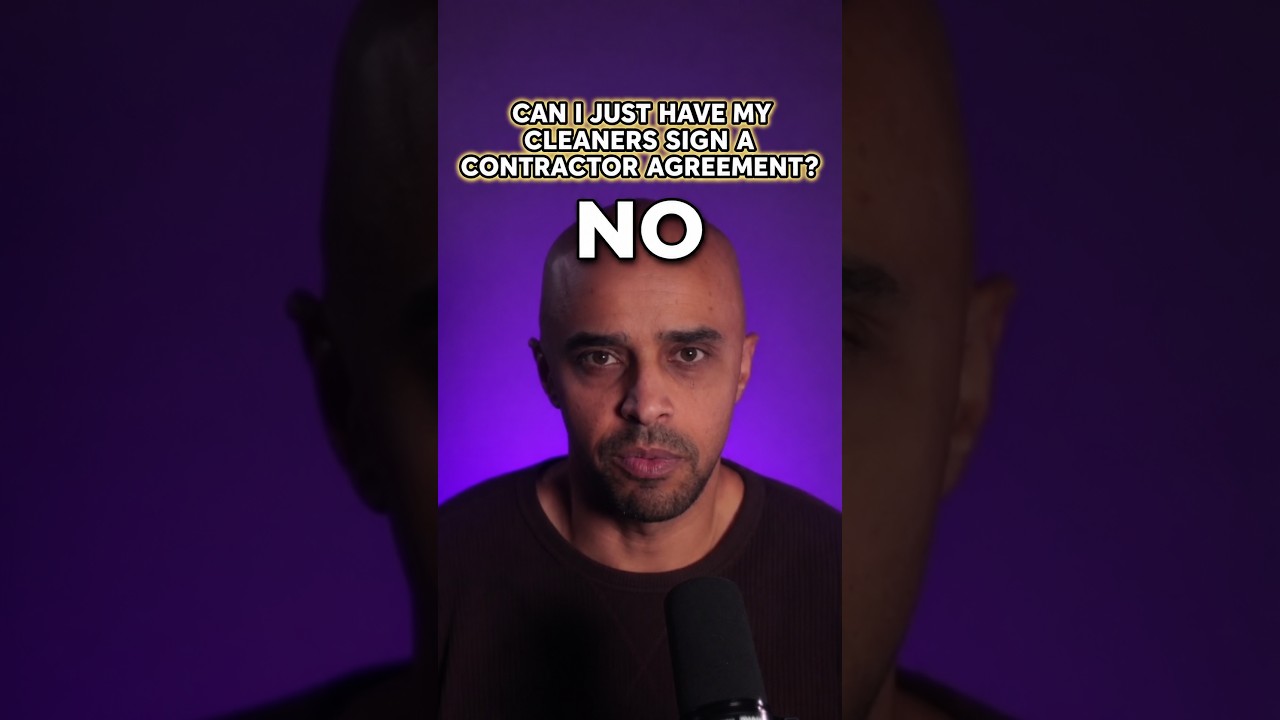
Can I just have them sign a contractor agreement?
No. The agreement matters, but classification is decided on conduct. An agency looks at who set the schedule, who supplied equipment and who could refuse work.
What if a cleaner asks to be an employee?
Then you are considering a different business model with payroll, withholding and workers compensation. It is a legitimate model, it is just not this one, and you cannot run both structures with the same person.
Is this different in every state?
Meaningfully, yes. Some states apply strict multi-part tests and some have specific provisions for referral arrangements. Two hours with a local attorney before you sign anyone is the cheapest insurance in this business.
Watch me answer it
Part of my complete guide: Legal basics